Photographing Sand Dunes - An Artistic Challenge
by Abhi Ganju
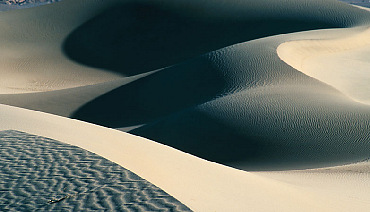
Drive by the Eureka dunes at midday,
and you’ll barely notice the insignificant mounds of dirt.
Yet, the right light can transform these mounds of dirt into a
photographer’s paradise - offering design, patterns, textures,
moods and storytelling.
First things first: LIGHT. Your main design element is
light and shadow. Therefore, you need bright contrasty light.
However, it still needs to be low-angled light, not overhead light.
Once the sun gets high, the mounds of dirt become exactly that,
mounds of dirt. Ergo, your best shots will be during the one and
a half hour at either end of the day. Early and late sunshine
bathes the scene with warm golden tones, adding drama. This means
that you will need to walk to the dunes about 30 to 40 minutes
before sunrise.
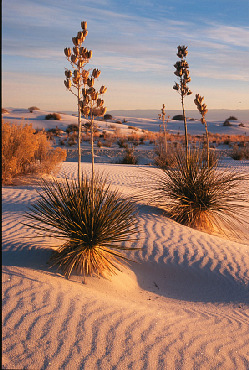
It’s important that you use a high contrast film, such
as Fuji Velvia. Polarizers and warming filters will enhance your
image too.
Exposure: the sand dunes are three dimensional objects.
Thus, different sides get different amounts of light. This makes
bracketing a must. Meter on a grey card, then bracket by two half
stops on either side.
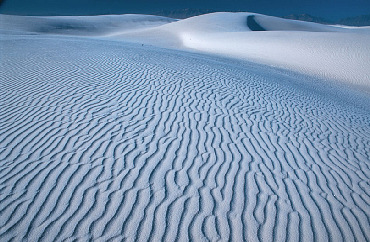
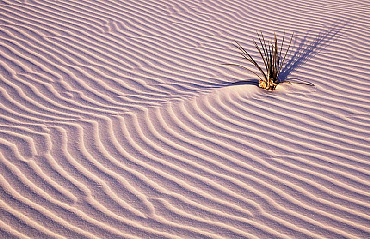
Composition: the most exciting design element are the
wind created ripples that are sharply defined by low-angled light.
Use them for a variety of close-ups, as well as for foreground
interest. Get in close to capture the texture of actual grains
of sand.
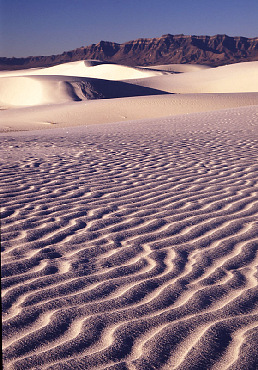
Compose scenic shots using a wide-angle lens (20-28mm range)
and a hyperfocal chart. For example, with a 24mm lens, at f/22,
I would set the lens focusing ring at 3.5 feet. I would set my
tripod low, keeping the camera about 2 feet from the closest ripples
in my viewfinder. Using the ripples for foreground, sand dunes
for middle ground, and distant mountains as background, I would
shoot some vertical as well as horizontal compositions. Desert
plants and mudcracks also make interesting foreground elements.
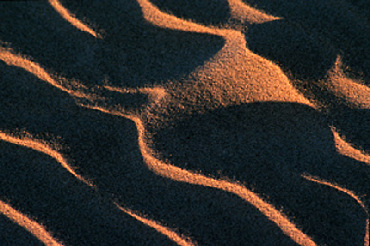
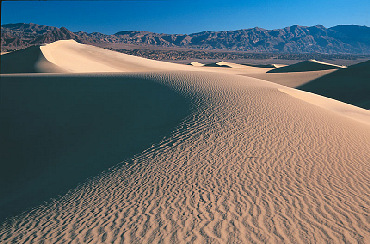
Walk around on the higher crests and look at the shadows of
the dunes. View them through a zoom lens (such as 70-300mm) and
try to isolate interesting patterns by combining the ripples,
dunes and their shadows. In bright light, the triangular crests
and their shadows will form bold geometric designs, whereas the
rounded dunes will form bold and sensuous designs. In diffuse
light, the same areas will form soft and sensuous designs. In
cloudy conditions (add warming filter), the sand will appear lighter
in color and give a softer mood. Depth of field is limited in
telephoto lenses, but using a small aperture and focusing a third
of the way in your frame will get you the best possible result.
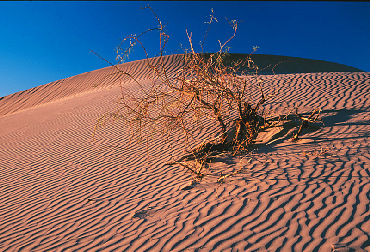
In some areas the ripples form swirls around a desert plant.
These leading lines make a pleasing composition as well as tell
a story. Similarly, mud cracks and tumbling weeds make interesting
story-telling shots.
Remember to shoot a scene before you “walk” into it,
except when you intend to have footprints in your composition.
The natural backdrop of mountains often turn obligingly pink
at sunrise and sunset. And with luck, you’ll get dramatic
skies at either end of the day.
Practical issues Plan about three to four days for the dunes,
to improve the chances of getting good light. On weekdays you’ll
find fewer footprints. Midday rest breaks could be a good idea:
walking on sand dunes is exhausting.
Getting there: Death Valley National Monument is on the
eastern border of California. The closest airport, Las Vegas,
is a three hour drive. Plan to stay at Stovepipe Wells, which
is closest to the Eureka dunes. Best times to visit are from November
to March.
White Sands National Monument is close to the town of Alamogordo,
New Mexico, about four hours drive from Albuquerque, two hours
from El Paso, Texas. Winter is best for dune photography, but
a variety of wildflowers can make for a fruitful spring photo
trip.
Contact Numbers for Death Valley & White Sands:
Death Valley visitor info:760-786-3200
White Sands visitor info: 505-679-2599
About the author...
Abhi Ganju is a physician and photographer who lives in the Chicago
area. Her images can be seen at www.abhisphotos.com.


 Profotos > Education
> Professional Photography Magazine > Pro Article
Profotos > Education
> Professional Photography Magazine > Pro Article