Catching the Cold
by Jess Lee
Winter photography gives us an opportunity
to capture scenes that are unique to many viewers. Streams, rivers
and lakes can be covered with pancake layers of ice or blanketed
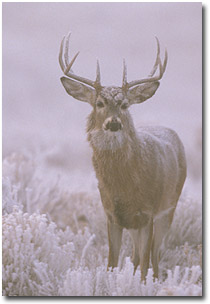
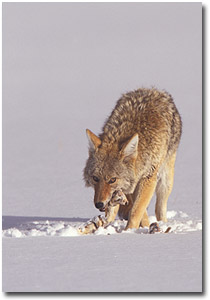
with pillows of powder snow. Animals covered in hoary frost appear
ghostlike in early morning ice fog. Even in the southwest you
can find icicles hanging against the red rocks. The variety of
subjects is only limited by our imagination. So let’s get
out, shoot away, and make great art. We can show the subjects
of our photos in a way that they have never been seen before.
Easy to say isn’t it? But there are challenges to overcome,
or at least cope with, before you can effectively make great photos
in the winter. Just a few speed bumps, little things such as:
frostbite, dead cameras, fogged lens, and those gray skies. But
hold on before you give up and head to San Diego or Fort Myers
- let me make a few suggestions.
First, take care of yourself. It doesn’t matter how well
your equipment is prepared if you can’t function in the cold.
You can be comfortable at most normal winter temperatures if you
dress right. For the sake of argument let’s say normal would
be down to 10 below. I think most would admit anything below this
is extreme and calls for extreme dress, such as arctic suits and
the like.
For normal days I recommend layering with the latest synthetics
from your favorite outdoor retailer. That would include thin gloves
layered with heavier ones, rubber-bottomed felt-lined boots and
a cap that will pull down to protect your ears. . Check out the
catalogs for the clothing that meets your needs. Don’t forget
to look at chemical hand warmers too - I bet you feel warmer already!
So now you can layer up or down as the conditions require to
remain comfortable. You have plenty of liquid to keep from becoming
dehydrated. Your pockets are lined with your favorite high-energy
snack to keep you going. Now you need to be concerned about how
you are going to keep your equipment working in the cold.
I like to start the day with the vehicle warmed up and then let
it cool down inside as I head towards my destination. This way
I am comfortable when I first head out into the cold, and I can
adjust to spending the day in a vehicle with the heater off or
on low. Remember, when getting in and out of a vehicle over the
course of the day, every bit of snow that comes in with you and
is melted will turn into water vapor that can put your equipment
out of business.
There are only a few things you need to keep in mind to help
your equipment continue to work in the cold -
Keep your camera and lens from getting warm too fast after they
have been in the cold or they will become covered in condensation
Keep batteries warm or they will rapidly loose energy
Don’t breath on the camera or lens
Simple but how do you do this and still use your equipment?
To keep equipment from becoming a victim of condensation, I use
two techniques. First - when you are outside using your gear,
try to keep it as dry as possible. I prefer to use plastic garbage
bags and rubber bands. You can find the big plastic bags anywhere
these days - I have picked them up at Hudson’s Bay Company
stores near the Arctic Circle. After any “cold soaking”
time outdoors, my gear goes in the plastic bags before it is brought
back into a vehicle or warm room.
The other technique is just as simple. Keep you gear cold once
it gets that way. When I bring my camera and lens back in the
vehicle, it is immediately covered with a dry coat, sleeping bag
or other insulation. The same applies when my gear enters a warm
room.
Most modern cameras need battery power. Digital imaging needs
lots of battery power. Bring spares. Keep your batteries warm
and they will hold their charge longer. These days I carry a DC
to AC power converter that is small and easy to bring along in
a vehicle. The converter plugs into the cigarette lighter and
I usually have a battery being charged when I am shooting.
When you leave the roadside to capture that perfect shot, there
are a couple things you can do to get to your location with less
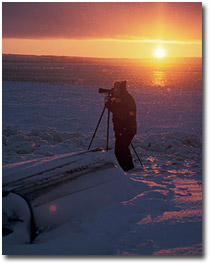
trouble. Even if you are not using skis or snowshoes, you should
consider using ski poles to help your balance and give that added
lift when you hit a low spot or drift. In deep snow there is a
special consideration - don’t spread your tripod legs wide
and stick them in the snow. This can lead to a bent or even broken
tripod. The snow will cause the legs to be pushed further apart
as weight is applied to the tripod. Keep the legs close together
as they enter the snow. The snow will help spread the tripod legs
and support your gear.
Following these suggestions should keep you and your equipment
going on your cold weather photo shoot.
So how do you make great photographs with winter’s sometimes
gray overcast sky?
Like any other season, if the sky is drab and boring, keep as
much of the gray out of the composition as possible. Remember
we are really photographing light and how you use its quality
will make or break your photograph. Dark foreboding skies can
be more interesting than blue skies with puffy clouds. If there
is a storm coming or leaving, watch for those spotlights breaking
through the clouds. Catch one of those beams of light on a subject
with a dark background and you have magic. Use shutter speeds
above 1/250 to catch falling snow flakes. If the light is flat
giving little texture to scenes, think about shooting that intimate
still life on snow or frost covered ground cover. Let the lack
of shadow work for you in flat light.
Another thing to consider would be those pesky exposure problems
brought on by all that light bouncing off a white surface and
being measured by a meter intended to look at neutral tones. The
quick and easy way to solve this problem is to take your meter
reading directly off the snow and adjust with positive compensation.
Somewhere between plus 1 and 2 should do the trick. On bright
sunny days, plus 1-2/3 works well with my Canon cameras. Higher
elevations with haze seem to require plus 2 while overcast can
bring proper compensation down to plus 1 stop. These are the times
that make that digital camera invaluable. Don’t clip your
histogram and you should be good to go.
So there you have it. Stay warm. Keep you gear dry and your batteries
charged. Let your imagination run wild. The low raking light of
winter can bring the sweetest images of the year.
I am looking forward to seeing yours.
About the author...
Over the past 30 years Jess's photos have appeared in a diverse
range of publications from National Geographic and Paris Match
magazines, to specialized publications such as Defenders of Wildlife
and Peterson's Hunting Annual. While past experience is one measure
of skill, Jess believes that what you are doing today is more
important. With that in mind, he continues to record the evolving
culture, lifestyles and especially the wildlife and wild places
of the North American West and beyond. You can view more of his
work at http://www.jessleephotos.com.
Jess also offers tours to some of the most inspiring and picturesque
places in the American West, including: Alaska, Yellowstone, the
Tetons and more. Be sure to check out Jess' photo workshops and
sign up for one (or two) here:
http://www.jessleephotos.com/tipsandtrips.htm


 Profotos > Education
> Professional Photography Magazine > Pro Article
Profotos > Education
> Professional Photography Magazine > Pro Article